The Path
FROM FIRST MOVEMENT TO DEEPER PRACTICE
EVERY PATH STARTS WITH THE BODY
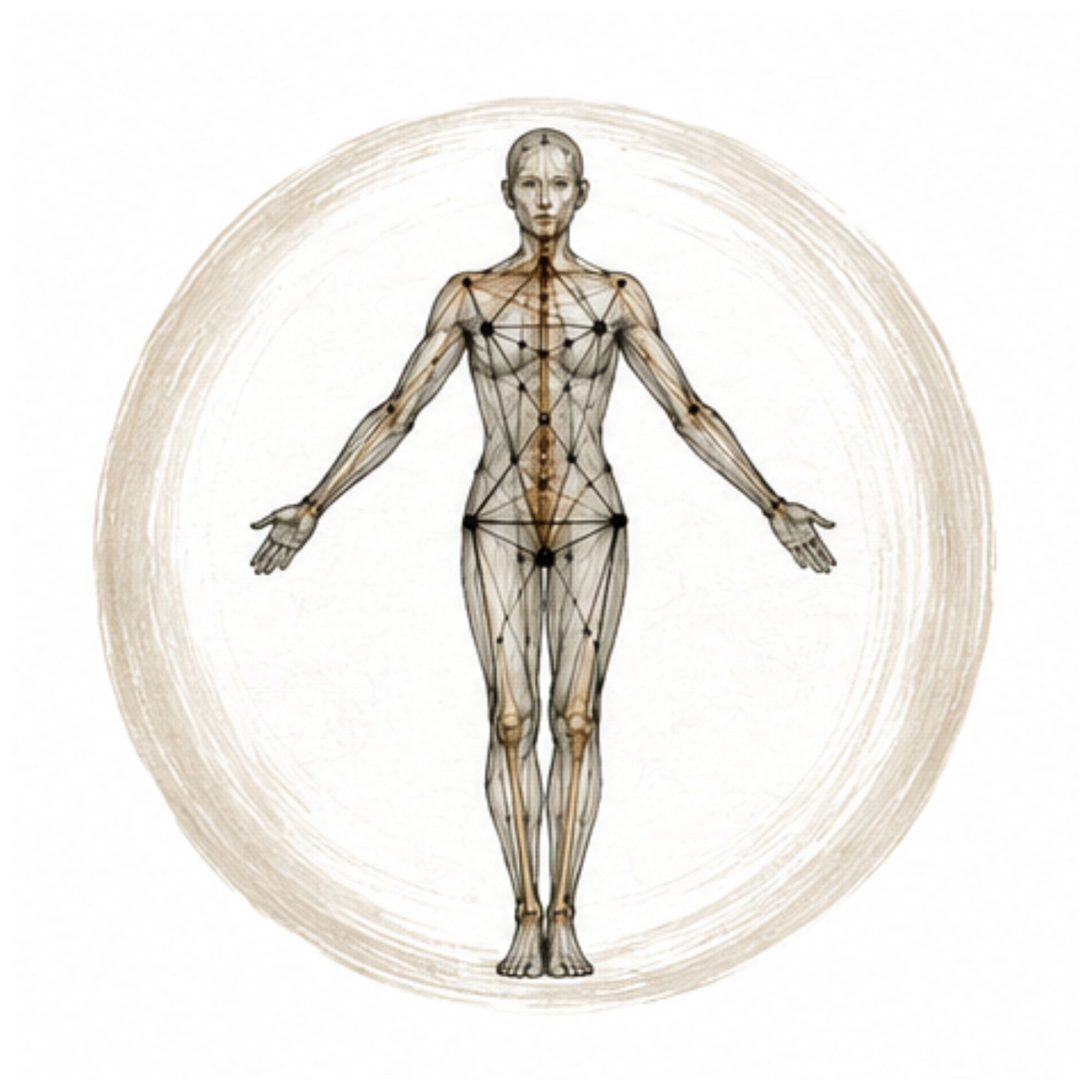
Kamaejutsu begins with something simple: learning to recognise how you stand, where your weight is and what happens when you begin to move.
There is no need to arrive with experience, flexibility or knowledge of Japanese martial arts. The first stage is about developing awareness of your own body and learning the fundamental kamae from which the practice grows.
Rather than rushing towards increasingly complex techniques, we build a foundation that can develop with you. Balance, posture and movement are explored gradually, allowing understanding to grow through practice.
- POSTURE — Discover how your body organises itself in kamae
- TIMING — Learn when and how weight and position begin to change
- FLOW — Gradually connect individual movements into continuous practice
LEARNING TO FIND YOUR BALANCE
The first structured step in Kamaejutsu is learning the Kamae no Kata: a traditional sequence through which the fundamental postures (kamae) of Japanese budō are learned and experienced.
Each posture places the body in a different relationship with gravity and the ground. Weight shifts between the legs, the hips organise themselves differently and the centre of the body moves. Through these changes, we begin to recognise what creates stability and what causes balance to change.
We do not practise these postures simply to reproduce their outward shape. We learn how the legs support the pelvis, how the hips organise the body and how unnecessary tension or small adjustments can influence our entire structure.
With repetition, posture, breathing and relaxation begin to work together. The body becomes more connected without becoming rigid, creating a stable foundation from which movement can develop.
Once we can recognise balance within a posture, we can begin to explore what happens between postures — when weight transfers, the centre moves and one position develops into the next.
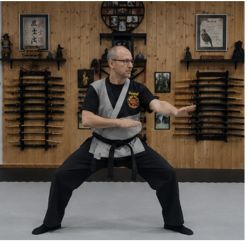
Posture
The fundamental postures (kamae) give us structure, but they are never intended to become rigid positions. Each stance places the body in a different relationship with its centre, the ground and the direction in which movement can develop.
Through practice, we become increasingly familiar with these changes. Posture becomes something we can recognise and organise from within, rather than a shape we constantly need to correct from the outside.
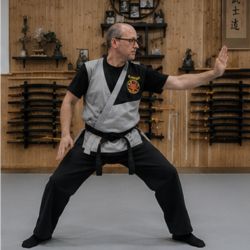
Timing
Balance becomes more challenging the moment a posture begins to change. Weight transfers, the hips move and the body has to reorganise itself while it is already in motion.
Timing is the ability to recognise when and how that change should occur. We learn not to rush from one stance to another, but to allow movement to develop while maintaining connection, control and balance.
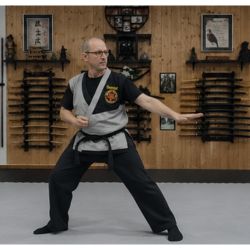
Flow
Flow connects these changing positions. Instead of treating each posture as a destination, we learn to recognise it as one moment within a continuous movement.
As Posture and Timing begin to work together, movement becomes smoother and less forced. The body learns to adapt continuously while remaining organised around its centre.
This is where Kamaejutsu becomes what it is designed to be: Postures in Motion.
LEARNING THROUGH FLOW
Once the Kamae no Kata has established the technical foundation, Kamaejutsu introduces the Flows: individual series of movements that further develop Posture, Timing and Flow through continuously changing positions.
The Flows are learned in sets of three, with each set connected to a Godai element. We begin with Chi — Earth, exploring its principles of grounding and stability before progressing through Water, Fire, Wind and Void.
Each Flow is learned progressively: first the sequence, then the balance within it, and finally the quality of the movement itself. As familiarity grows, practising more slowly demands greater precision in every transfer of weight, change of posture and movement of the centre.
After the first five sets have introduced the five elements, the advanced Flows return to these elements at a deeper level, allowing their principles to be explored with greater awareness of balance, breathing and inner energy. Ultimately, the system develops to 30 individual Flows, which can be connected into an effectively endless sequence of movement and practised as a form of moving meditation.
PROGRESS AT YOUR OWN PACE
Kamaejutsu follows a structured path of development, but progression is measured primarily through experience and practice, not by how quickly you reach the next grade.
Traditional coloured belts can mark the different stages of the curriculum, but examinations are optional. Whether a student chooses to grade or not, the foundation remains the same: everyone continues to learn and develop the unarmed Flows as they progress through Kamaejutsu.
For students who choose the examination path, selected postures are also practised with traditional Japanese weapons. The weapons are used purely as training tools. Their weight, length and balance place different demands on the body, creating another way to refine posture, movement, centre and control.
Students who do not wish to grade simply continue through the unarmed curriculum without this additional examination component. The belt marks experience within the system; the practice itself remains the path of development.
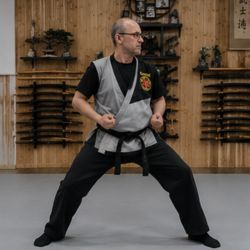
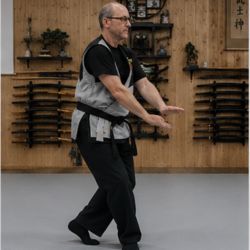
The posture is the same. What we experience within it continues to change.
A DEEPER PRACTICE
As the Kamae no Kata and the Flows become familiar, less attention is needed simply to remember the movements. This creates space to explore what is happening within the movement itself.
The same Kamae no Kata that first taught us posture and balance can now be practised with greater attention to breathing, relaxation and connection throughout the body. By reducing unnecessary tension and moving with greater precision, we begin to experience how energy can flow through a balanced and organised structure.
The Flows deepen in the same way. Slower movement demands greater control of the centre and makes subtle changes in balance increasingly noticeable. Physical movement, breathing and attention gradually begin to function as one connected practice.
Kamaejutsu therefore does not leave its foundations behind as we advance. We return to them with a deeper level of awareness.
DEEPENING THE FIVE ELEMENTS
The Five Elements — Earth, Water, Fire, Wind and Void — are already part of Kamaejutsu through the Flows. As experience grows, their principles can be explored beyond the physical qualities of movement.
This deeper practice leads into Godai Meiso — Meditation of the Five Elements. Posture, breathing and movement are used to develop greater awareness of the relationship between body, mind and inner energy.
Rather than leaving Kamaejutsu behind, Godai Meiso builds upon its foundations. The same elements encountered through the Flows are explored at a deeper and increasingly meditative level.
Godai Meiso is an advanced practice offered exclusively to selected students who are ready to explore this deeper path. It is not a required stage of Kamaejutsu, but a further development for those invited to continue into this level of practice.
WALK YOUR OWN PATH
Kamaejutsu offers a structured practice, but the path remains personal. From the foundations of Kamae no Kata to Postures in Motion, the Flows and the deeper exploration of the Five Elements, each stage provides another opportunity to understand your own balance, movement and awareness.
There is no need to rush towards the next level. Progress comes through practice, attention and experience.