ORIGINS
TRADITION • LINEAGE • DEVELOPMENT
Kamaejutsu did not begin with the invention of new postures. It began with a question about traditional ones: what happens when kamae are no longer approached primarily as positions, but as moments within continuous movement?
BEFORE KAMAEJUTSU
Kamaejutsu developed from more than twenty-five years of training and exploration within Japanese martial arts. At the centre of that experience were the body structures, principles of movement and kamae encountered within the martial traditions associated with the Bujinkan and Takamatsu-den.
In these traditions, kamae are inseparable from movement. They organise the body in relation to balance, direction, distance and potential action. Yet in martial training they are normally encountered within a much larger technical context: striking, receiving attacks, evasion, grappling, weapons and kata.
Kamaejutsu began by doing something different.
It removed the opponent.
It removed the need to complete a martial technique.
And it asked what remained when the kamae themselves — and the transitions between them — became the subject of practice.
That distinction is fundamental. Kamaejutsu did not invent the traditional kamae from which it began. It changed the context in which they are studied.
LINEAGE & TRANSMISSION
The historical background matters because Kamaejutsu should not be presented as though its traditional foundations appeared without a line of transmission.
Toshitsugu Takamatsu (1889–1972) was the teacher of Masaaki Hatsumi. Hatsumi subsequently founded the Bujinkan and taught material associated with nine martial traditions.
For Kamaejutsu, however, this lineage must be understood correctly.
It is not the lineage of Kamaejutsu.
It is part of the lineage through which traditional martial knowledge reached the training from which Kamaejutsu eventually developed.
TWO HISTORIES
TRADITIONAL TRANSMISSION
Takamatsu
↓
Hatsumi
↓
teachers • traditions • study
DEVELOPMENT OF KAMAEJUTSU
traditional material
↓
study and experimentation
↓
Kamaejutsu
WHERE THE DISTINCTION MATTERS
Those histories meet, but they are not interchangeable.
This distinction allows Kamaejutsu to acknowledge its sources without claiming an antiquity or Japanese ryūha lineage that belongs to the traditions from which it learned.
THE MASTERS
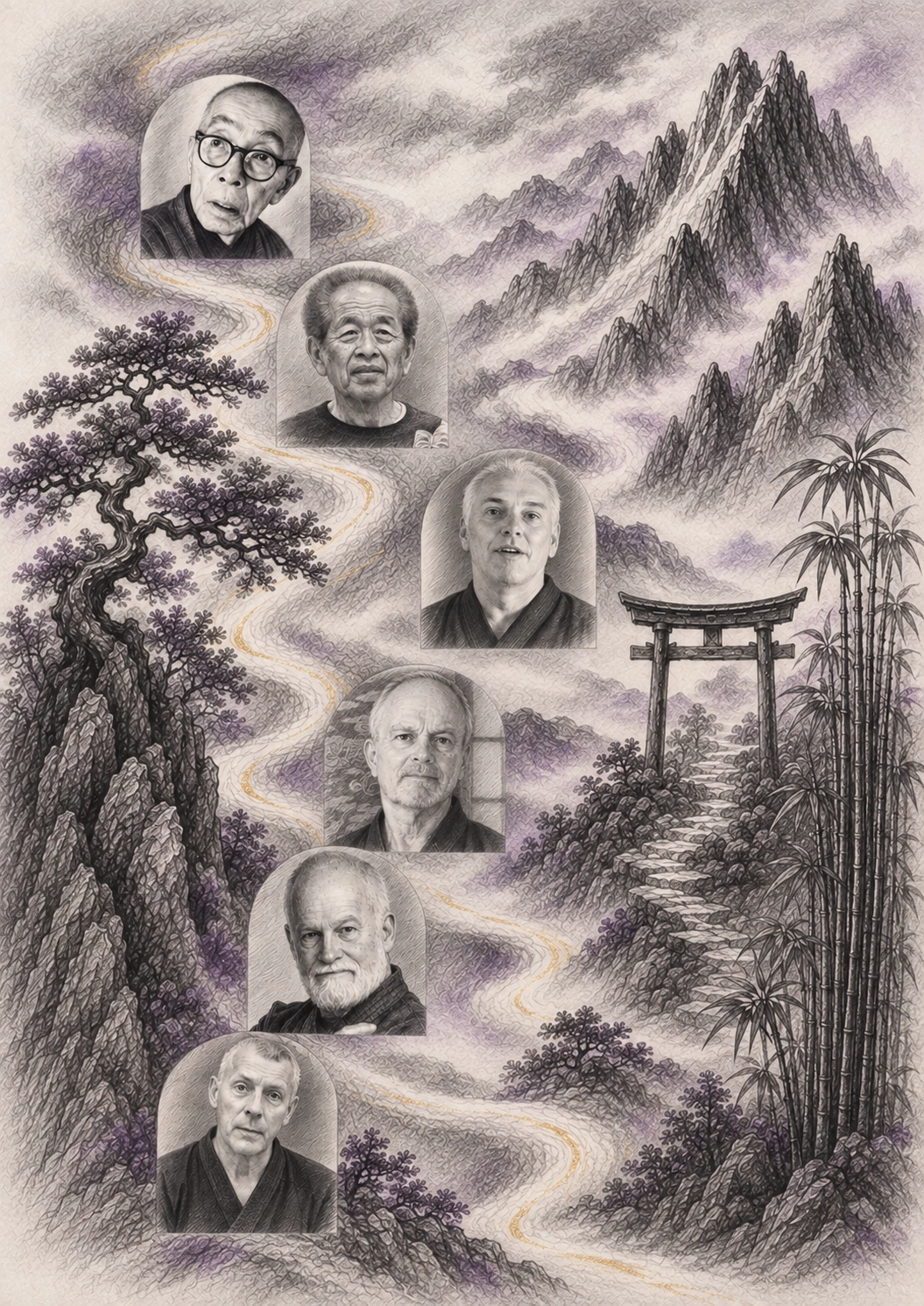
My path through Japanese martial arts has been shaped by different teachers, traditions and approaches. They do not represent a single consecutive lineage leading to Kamaejutsu. Together, they represent important lines of transmission, training and study within my own development.
TOSHITSUGU TAKAMATSU
O'Sensei
MASAAKI HATSUMI
Sōke — Bujinkan
GUUS LEKANNE DIT DEPREZ
Kancho — The Iga Warriors of Enlightenment
RICHARD VAN DONK
Doshi — IBDA / Bushindo University
STEPHEN K. HAYES
An-Shu — To-Shin Do
DENNIS BARTRAM
Soke — Hichibuku Goshinjutsu / Amatsu Tatara
WHERE KAMAEJUTSU BEGINS
The Kamae no Kata became the filter through which this exploration could be organised.
The individual kamae provided recognisable structures. But instead of treating completion of each posture as the objective, attention moved towards the transition:
How do I get there?
What changes on the way?
When does one posture stop being one posture and begin becoming another?
This led to the development of the Flows.
The Flows connect structures into continuous sequences. They are not intended simply as choreography to memorise. They provide a framework in which the practitioner can repeatedly examine what happens while the body changes.
THE TRANSITION
KAMAE
↓
MOVEMENT
↓
KAMAE
The practice is found in what happens between the postures.
POSTURE
The organisation of the body at any given moment.
TIMING
Recognition of when change begins and when movement needs to occur.
FLOW
The ability to continue through change without unnecessarily interrupting movement or losing structure.
POSTURES IN MOTION
Together these principles became POSTURE • TIMING • FLOW.
This is where the history of the source material and the history of Kamaejutsu separate. The kamae have older roots.
Kamaejutsu is the modern method developed to explore them in this particular way.
FROM KAMAE TO GODAI
As Kamaejutsu developed, simply connecting postures was not enough. A practice needed structure without turning movement back into a collection of rigid techniques.
The Godai — Chi, Sui, Ka, Fū and Kū — provided a framework through which different qualities of movement could be explored.
The Kamae no Kata establishes the foundation. The Flows then progressively explore movement through that foundation.
The purpose is not to reproduce a historical martial system outside its original context, but to preserve a meaningful connection with the traditional material while allowing a different practice to emerge from it.
KAMAEJUTSU
POSTURES IN MOTION
Traditional kamae provided the foundation.
Years of practice raised a different question: what happens when the transition itself becomes the practice?
Kamaejutsu developed from that question.
It does not claim to be an ancient ryūha. It is a modern practice with acknowledged traditional roots — exploring posture, timing and flow through movement.